🛡️ Assyriological Military & Intellectual Historiography
An exhaustive scholarly investigation into the Neo-Assyrian Empire (c. 911–609 BCE)—the ancient world’s first true military superpower. This treatise examines the revolutionary military logistics introduced by Tiglath-Pileser III, the engineering mechanics of monumental siege engines, the strategic population deportation policies (nasahu), and the intellectual synthesis of the Royal Library of Ashurbanipal at Nineveh.
Between the tenth and seventh centuries BCE, the Neo-Assyrian Empire (c. 911–609 BCE) expanded from its arid heartland along the Upper Tigris River to conquer an unprecedented expanse encompassing all of Mesopotamia, the Levant, southeastern Anatolia, parts of western Iran, and, at its zenith, Pharaonic Egypt. In doing so, the kings of Nineveh, Kalhu (Nimrud), and Dur-Sharrukin (Khorsabad) established the ancient world’s first true trans-regional super-empire. The terror of Assyrian military might became legendary throughout antiquity, immortalized in the vibrant stone bas-reliefs of royal palaces, the apocalyptic prophecies of the Hebrew Bible, and the boastful royal annals of Ashurnasirpal II, Sennacherib, and Esarhaddon.
Yet to characterize the Neo-Assyrian Empire merely as a rapacious, bloodthirsty war machine is to fundamentally misunderstand its historical genius. Assyrian hegemony was a triumph of systematic state engineering: the creation of the world’s first professional standing army, revolutionized military logistics, standardized iron weaponry, advanced siegecraft engineering, and a calculated imperial administrative policy of mass population resettlement. Simultaneously, this relentless imperial expansion was coupled with an extraordinary intellectual endeavor: King Ashurbanipal’s systematic collection, preservation, and curation of the entirety of Mesopotamian cuneiform literature, creating the world’s first comprehensively organized royal library at Nineveh.
The historical trajectory of Assyria presents a compelling study in imperial sustainability. Surrounded by hostile mountain tribes in the Zagros and Taurus ranges and volatile nomadic pastoralists in the Syrian steppe, the Assyrian state developed a militarized civic ethos centered around the supreme national deity, Ashur. Military conquest was not viewed merely as secular geopolitical expansion, but as a sacred cosmic duty: Ashur demanded that the disorder of foreign chaos be brought into the civilized cosmos through the sword of the Assyrian king.
1. Tiglath-Pileser III and the Creation of the Professional Army
Prior to the mid-eighth century BCE, Assyrian military campaigns were constrained by the seasonal limitations of a peasant militia. Armies could only march during the dry summer months after the spring barley harvest had been collected, and soldiers were compelled to return home for autumn sowing. This structural vulnerability left the empire vulnerable to hostile nomadic incursions and rebellious vassal coalitions.
The structural transformation of Assyria into an unstoppable military superpower was the work of one of history’s greatest administrative reformers: Tiglath-Pileser III (reigned 745–727 BCE). Seizing the throne amid civil war and plague, Tiglath-Pileser fundamentally revolutionized every branch of the imperial state:
- The Kisir Sharruti (Royal Standing Army): Tiglath-Pileser abolished the unreliable seasonal citizen levy in favor of a permanent, highly disciplined standing army (kisir sharruti). Soldiers were enlisted for multi-year terms, maintained year-round, equipped with standardized state-manufactured iron weapons and scale armor, and drilled continuously in tactical maneuvering. For the first time in world history, a state possessed the logistical capability to wage continuous winter campaigns across distant mountain ranges and scorching deserts.
- Systematic Provincial Annexation: Previous Assyrian monarchs had relied on loose, predatory tributary arrangements: conquered vassal kings were left on their thrones, paying heavy annual tribute under threat of punitive raids. Tiglath-Pileser dismantled this fragile system. Rebellious kingdoms were systematically extinguished, their native dynasties liquidated, their territories divided into smaller, manageable provinces, and placed under the direct authoritarian rule of imperial governors (bel pihati) bound directly to the king.
- The Imperial Courier Network: To maintain real-time strategic control over this sprawling empire, the Assyrians created the kalliu postal network. Staging posts, way-stations, and fresh relays of royal horses were established along paved military roads connecting Nineveh with distant garrisons from the Persian Gulf to the Mediterranean coast. Royal dispatches, intelligence briefs, and troop orders traveled hundreds of miles in a matter of days.
Armament and Combined Arms Tactics
The tactical superiority of the Assyrian army stemmed from its unprecedented mastery of combined arms. Rather than relying solely on infantry charges or noble chariot duels, the Assyrian general staff deployed specialized, interlocked tactical divisions working in lethal harmony:
- Heavy Infantry Phalanxes: Frontline spearmen armed with long ash spears and massive round bronze-embossed wicker shields (aritu), supported by short-sword secondary shock units.
- Paired Archer Units: Foot archers equipped with powerful composite horn-and-wood bows were paired with dedicated shield-bearers carrying massive, curved gabled pavises made of wicker and leather. The shield-bearer completely shielded the archer from enemy counter-fire, allowing the marksman to unleash continuous, deadly volleys from behind portable wooden battlements.
- Cavalry Revolution: The Assyrians pioneered the effective tactical use of mounted cavalry. While early cavalrymen operated in pairs—one rider guiding the reins of both horses while the other drew a bow—by the reign of Sennacherib, cavalrymen were equipped with iron scale cuirasses, leather saddles, and specialized archery techniques that allowed lone horsemen to fire accurately while maneuvering at high gallop.
| Military Branch / Weapon System | Assyrian Technological Innovation | Tactical Operational Function | Historical Battlefield Impact |
|---|---|---|---|
| Battering Ram / Siege Engine | Multi-wheeled timber siege towers equipped with suspended iron-headed pendulum rams and wicker archer turrets | Breaching mudbrick city walls and burning upper fortifications | Systematic reduction of heavily fortified Levantine and Elamite citadels (e.g., Lachish, Susa) |
| Composite Bow Infantry | Recurved composite bows constructed of laminated horn, sinew, and wood with iron-tipped armor-piercing arrows | Massed indirect saturation fire and high-angle wall parapet clearing | Suppression of defending enemy garrisons from extreme standoff ranges |
| Combat Engineers & Sappers | Specialized corps equipped with iron picks, scaling ladders, inflatable goatskin water bladders, and pontoon bridges | Subterranean tunneling beneath curtain walls, trenching, and rapid river crossings | Neutralization of natural water barriers like the Tigris, Euphrates, and Orontes rivers |
| Standing Cavalry (Pethallu) | Iron-scaled mounted archers and lance-bearing lancers with high-pommel saddle cloths | Rapid outflanking, tactical shock pursuit of broken enemy formations, and border patrols | Replaced slow war chariots as the primary instrument of battlefield mobility |
2. Mass Deportation and Imperial Resettlement Statecraft
One of the most defining and chilling features of Neo-Assyrian statecraft was the deliberate, state-administered policy of mass population relocation, known in Akkadian as Nasahu (‘uprooting’). Historical and epigraphic studies indicate that over the course of three centuries, the Assyrian imperial administration forcibly relocated an estimated 4.5 million individuals across the Near East.
Contrary to modern assumptions of ethnic cleansing, the primary objective of Assyrian deportation was not genocide or the extermination of subject peoples, but radical socio-economic and demographic engineering:
- Decapitation of Local Rebellions: When an indigenous province rebelled, the Assyrian state deported its political elite, royal family, priests, military officers, and skilled metallurgical artisans, completely shattering local kinship networks and nationalist identity. Without leadership or weapons specialists, the remaining peasant population could not organize coordinated resistance.
- Strategic Economic Redeployment: Conquered peoples were treated as valuable imperial human capital. Skilled Aramean scribes, Phoenician shipbuilders, Judean olive-oil technicians, and Babylonian weavers were systematically resettled into the imperial core cities—Nineveh, Kalhu, and Dur-Sharrukin—to construct monumental palaces, dig grand canals, and staff royal manufacturing guilds.
- Homogenization and Imperial Integration: Deportees were provided with state rations, draft animals, seeds, and granted imperial land allotments in underpopulated agricultural frontier zones. Once resettled, they were integrated into the empire as royal subjects, protected by Assyrian law, and assimilated into a common imperial identity, accelerated by the adoption of Aramaic as the lingua franca of imperial administration.
The famous Lachish Reliefs, excavated from Sennacherib’s Southwest Palace at Nineveh, offer graphic visual verification of this policy: alongside scenes of siege ramps and impaled Judean officers, long peaceful columns of Judean families are shown marching with their ox-drawn wagons and possessions, escorted by Assyrian quartermasters toward resettlement areas.
3. Ashurbanipal and the Universal Royal Library of Nineveh
While his predecessors achieved immortality through military conquest, King Ashurbanipal (reigned 668–627 BCE) secured his eternal legacy through an unprecedented intellectual obsession. Ashurbanipal was unique among Assyrian monarchs: he had been educated not only in horsemanship, archery, and royal statecraft, but in the most esoteric arts of the scribal curriculum. In his royal inscriptions, Ashurbanipal proudly boasted:
‘I, Ashurbanipal, learned the wisdom of Nabu, all the scribal arts of every kind, and gathered the lore of all the masters. I can solve the most intricate divisions and multiplications; I have read the artfully written text in Sumerian and the obscure Akkadian which is difficult to master; I have inspected stone inscriptions from before the Deluge.’
Recognizing that political power was inextricably bound to metaphysical and textual authority, Ashurbanipal dispatched royal commissioners, scholars, and armed squads across the ancient cities of Babylonia—Nippur, Babylon, Borsippa, Uruk, and Sippar—with strict imperial commands to confiscate, copy, and transport to Nineveh every cuneiform tablet in existence. His royal decree issued to the governor of Borsippa commanded: ‘Seek out all rare tablets that your scribes know of and which are not in Assyria, and send them to me. No one shall withhold any tablet from you!’
Cataloging and Legacy of the Kuyunjik Collection
Within the royal palaces on the mound of Kuyunjik in Nineveh, Ashurbanipal created the ancient world’s first systematically classified, indexed library. Over 30,000 clay tablets and fragments were meticulously organized into dedicated wooden storage chests and wall niches, equipped with clay tag labels (colophons) indicating the tablet’s serial number, series title, the scribe who copied it, and the royal library stamp: ‘Property of Ashurbanipal, King of the World, King of Assyria’.
The library encompassed the entire encyclopedic universe of Ancient Near Eastern thought:
- Canonical Literature: The definitive twelve-tablet standard edition of the Epic of Gilgamesh (edited by the master scholar Sin-leqi-unninni), the Babylonian creation epic Enuma Elish, the myth of Etana, and the descent of Ishtar to the Netherworld.
- Divinatory & Astrological Compendia: Vast multi-volume omen series, including Enuma Anu Enlil (celestial omens), Shumma Alu (terrestrial omens), and hepatoscopic omen manuals for inspecting sheep livers.
- Scientific & Medical Treatises: Extensive pharmacopeias listing medicinal herbs, botanical ointments, mineral remedies, and surgical manuals detailing treatments for bone fractures, fevers, and eye infections.
- Bilingual Lexical Dictionaries: Invaluable Sumerian-Akkadian dictionaries, grammatical paradigms, and phonetic glossaries that modern 19th-century philologists—such as Sir Austen Henry Layard, Henry Rawlinson, and George Smith—used to decipher the cuneiform script and unlock the forgotten history of Mesopotamia.
The Royal Lion Hunt Reliefs and Sovereign Ideology
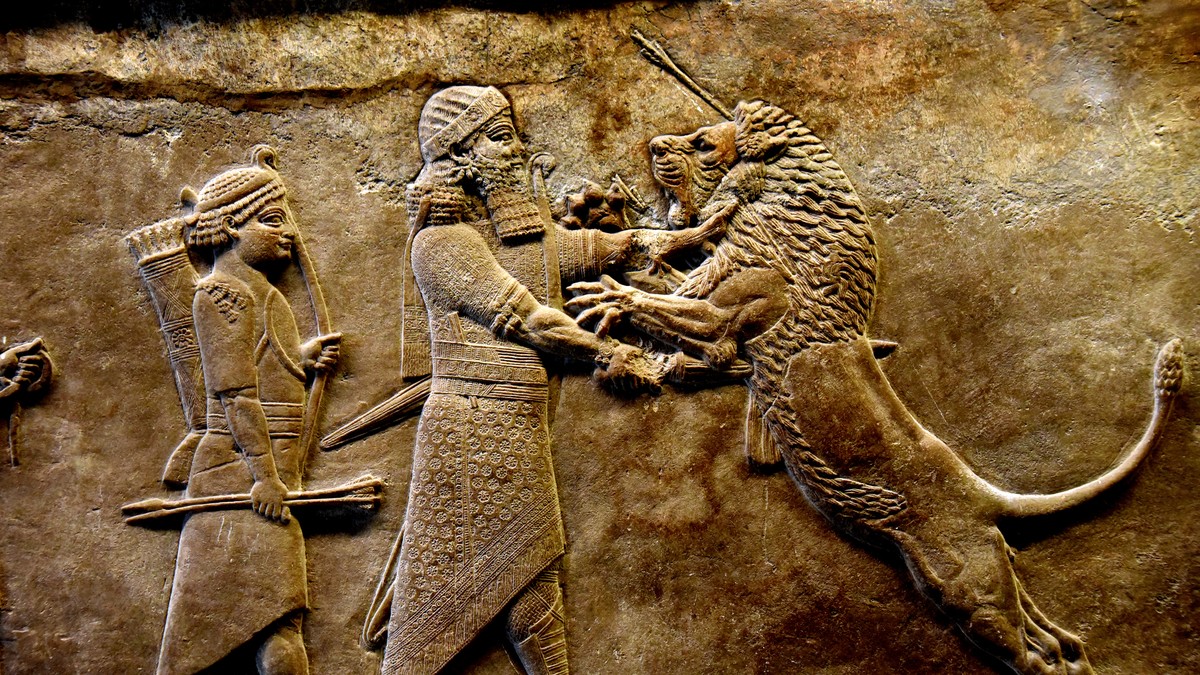
The philosophical ideology underpinning Neo-Assyrian military dominance found its supreme visual expression in the magnificent carved gypsum bas-reliefs decorating the royal palaces of Ashurnasirpal II at Nimrud and Ashurbanipal at Nineveh (now preserved in the British Museum). Foremost among these are the world-renowned Lion Hunt of Ashurbanipal reliefs from the Northern Palace.
In Mesopotamian cosmology, the wild lion (neshu) was not simply an apex predator of the river marshes; it was the physical embodiment of unbridled cosmic chaos, violent nature, and moral rebellion against the gods. By venturing into royal arenas or open steppes in his war chariot to slay ferocious lions with composite bow, javelin, and bare-handed dagger thrusts, the Assyrian king engaged in a sacred liturgical drama. The king demonstrated that he was the invincible champion of divine order (kittum), uniquely chosen by the god Ashur and the goddess Ishtar to tame the wild savagery of the outer wilderness and protect his flock.
The anatomical realism, dramatic tension, and emotional pathos captured by Assyrian sculptors—such as the poignant image of a dying lioness, paralyzed by arrows through her spine, roaring in defiance with her final breath—represent the pinnacle of ancient relief sculpture. These stone narratives lined the corridors where foreign ambassadors and vassal monarchs waited in audience, serving as an intimidating psychological declaration of the king’s supreme physical valor and divine backing.
4. The Siege of Lachish and Psychological Warfare
The terrifying efficiency of the Assyrian war machine is nowhere better documented archaeologically than at the Judean fortress city of Lachish (modern Tell ed-Duweir, Israel), besieged and destroyed by Sennacherib in 701 BCE during his punitive campaign against King Hezekiah of Judah.
Excavations led by David Ussishkin revealed the only surviving monumental stone siege ramp from antiquity: a massive wedge constructed of over 20,000 tons of fieldstones, packed against the outer curtain wall of Lachish. Up this colossal stone ramp, Assyrian combat engineers pushed multi-wheeled siege towers armed with heavy battering rams. The defending Judeans desperately constructed a counter-ramp inside the city and hurled incendiary pitch torches at the timber rams, but Assyrian water-throwers continually doused the wooden structures with water bladders.
Once the walls were breached, the Assyrians enacted calculated psychological terror. Palace reliefs depict captured Judean commanders being stripped naked, flayed alive, and impaled on wooden stakes before the smoking ruins of the city gates. By deploying gruesome, public atrocities against rebel leaders while simultaneously treating yielding cities with relative leniency, the Assyrian general staff weaponized psychological terror to induce preemptive capitulation across the Levant, saving imperial forces the costly delays of protracted sieges.
The Sudden Collapse: The Fall of Nineveh in 612 BCE
Despite its terrifying military dominance and sophisticated administrative structures, the Neo-Assyrian Empire suffered from fatal structural vulnerabilities that precipitated its shockingly abrupt collapse within two decades of Ashurbanipal’s death (c. 627 BCE). Constant military mobilization had drained the agrarian manpower of the Assyrian homeland; prolonged civil wars between rival imperial claimants fractured the officer corps; and the relentless extraction of tribute bred unquenchable hatred among conquered subjects.
Taking advantage of these fractures, an unprecedented geopolitical alliance formed between the Chaldean dynasty of Babylon under King Nabopolassar and the rising Iranian power of the Medes under King Cyaxares. In a swift, devastating blitzkrieg, the coalition armies swept up the Tigris River. In 614 BCE, the ancient religious capital of Ashur was sacked; in 612 BCE, after a three-month siege, the monumental walls of Nineveh were breached when spring floodwaters undermined the Khosr River water gates. The great palaces were plundered and burned, and the Assyrian Empire vanished from the geopolitical map, paving the way for the rise of the Neo-Babylonian Empire and the Achaemenid Persian Empire.
🏛️ Historical Retrospective
When Nineveh fell to a combined coalition of Medes and Babylonians in 612 BCE, the great palaces were put to the torch. Ironically, the catastrophic fires baked and hardened the sun-dried clay tablets, permanently preserving Ashurbanipal’s library beneath the ash ruins for 2,500 years. Through this unintended miracle of archaeological preservation, Assyria bequeathed to humanity the deepest literary and spiritual memories of ancient Mesopotamian civilization.