⚔️ Roman Military Historiography Overview
A rigorous operational and tactical analysis of the Roman legionary apparatus. This monograph traces the evolution from the archaic manipular legion of the Punic Wars through Gaius Marius’ professionalization reforms, cohortal deployment physics, siege warfare engineering, and the castramentation logistics that fortified the imperial frontiers (Limes).
The territorial conquest and administrative consolidation of the Roman Empire was accomplished through the most disciplined, technologically adaptable, and logistically sophisticated heavy infantry military apparatus in classical antiquity: the Roman Legion (Latin: Legio, derived from legere, ‘to choose or levy’). Over eight centuries of continuous operational evolution—from the agrarian tribal militia that fought Etruscans and Samnites on the rugged hills of Latium, to the professional standing army that garrisoned Hadrian’s Wall in Britannia and the Euphrates frontier in Syria—the Roman military demonstrated an unmatched capacity to absorb catastrophic battlefield defeats, ruthlessly adopt the superior weapons and tactics of its enemies, and rebuild its armies with terrifying institutional tenacity.
Where Greek military thought was dominated by the rigid, monolithic hoplite phalanx and Macedonian sarissa pike-block, Roman military engineering prioritized tactical flexibility, modular subdivision, multi-layered depth, and devastating short-range missile preparation. The transformation of this military system—culminating in the revolutionary reforms instituted by the general Gaius Marius at the close of the second century BCE—transformed the Roman soldier from a seasonal, property-owning citizen-farmer into a lethal, standardized, full-time professional warrior whose tactical cohesion, engineering prowess, and castramentation discipline paved the paved roads upon which Pax Romana was forged.
1. The Manipular Legion: The Polybian ‘Phalanx with Joints’
Prior to the Marian reforms, the Republican army operated under the Manipular System (described in meticulous detail by Polybius), developed during the brutal mountain campaigns of the Samnite Wars (343–290 BCE). Recognizing that the solid Greek phalanx was hopelessly vulnerable on broken, undulating terrain, Roman tacticians shattered the rigid phalanx into thirty independent, agile tactical units called maniples (‘handfuls’), each consisting of two centuries commanded by two centurions.
The manipular legion was arrayed in a checkerboard formation across three distinct tactical battle lines according to age, combat experience, and wealth: the famous Triplex Acies:
- The Hastati (First Line): The youngest, most aggressive men in the prime of youth, arrayed in ten maniples of 120 men each. Their mission was to absorb the initial shock of the enemy charge, launch their heavy javelins, and engage in ferocious close-quarters melee.
- The Principes (Second Line): Proven, seasoned veterans in their late twenties and thirties, wearing superior chainmail armor, positioned directly behind the gaps in the first line. If the Hastati failed to break the enemy, they executed a synchronized tactical withdrawal through the gaps, allowing the fresh, experienced Principes to step forward and renew the crushing assault.
- The Triarii (Third Line): The oldest, most battle-hardened veterans, kneeling on one knee behind their large shields with their heavy thrusting spears pointed forward. The Triarii functioned as the ultimate strategic reserve. If the battle turned into a catastrophic rout, the Hastati and Principes retreated between the ranks of the Triarii, who locked shields to halt the pursuing enemy. Hence arose the common Roman proverb for a desperate crisis: ‘Res ad triarios rediit’ (‘It has come to the Triarii’).
| Legionary Historical Era | Primary Tactical Unit | Recruitment Criteria | Standard Infantry Armament | Logistical System |
|---|---|---|---|---|
| Early Republic (Polybian) | Maniple (120–160 men, 30 per legion) | Property-owning citizens only (5th class census); self-funded arms | Hastati/Principes: Pilum & Gladius; Triarii: Hasta spear | Seasonal conscription; soldiers return home for harvest |
| Late Republic (Marian) | Cohort (480 men, 10 cohorts = 4,800) | Open to landless proletariat (capite censi); state-issued arms | Universal standardization: Pilum, Gladius Hispaniensis, Scutum | Permanent standing army; soldiers carry own gear (‘Marius’ Mules’) |
| Principate Imperial | Cohors (expanded 1st cohort = 800 men) | Roman citizens across provinces; 25-year service contract | Segmented plate armor (Lorica Segmentata); Pugio dagger | Imperial frontier fortress network; state military treasury (aerarium militare) |
| Late Roman (Dominate) | Limitanei (border guards) & Comitatenses | Hereditary conscription & Germanic federate barbarians | Plumbata darts, Spatha longsword, oval dished shields | Mobile strategic field armies; extensive cavalry integration (Equites) |
2. The Marian Reforms: The Birth of the Professional Legionary
By 107 BCE, the Republican military apparatus was facing acute operational paralysis. Devastating military defeats against the Numidian King Jugurtha in North Africa and the annihilation of eighty thousand Roman soldiers by migrating Germanic Cimbri and Teutones tribes at the Battle of Arausio (105 BCE) exhausted Rome’s traditional manpower pool. The property-owning citizen farmers who met the census qualifications for military service had been largely bankrupted by foreign wars.
Elected consul, the brilliant military general Gaius Marius enacted a revolutionary sweep of structural reforms that permanently dismantled the citizen-militia and birthed the professional Roman army:
- Abolition of the Property Qualification: Marius opened military enlistment to the vast, untapped urban underclass: the Capite Censi (‘those counted merely by the head’) or Proletarii. For the first time, impoverished men volunteered in droves, viewing military service as a professional career offering steady pay, plunder, and the promise of a land allotment upon discharge.
- State-Issued Standardized Equipment: Because the new recruits lacked financial resources, the state assumed responsibility for supplying standardized weapons, armor, rations, and uniforms, eliminating the disparate weapon classes of Hastati, Principes, and Triarii. Every legionary was now a uniform, interchangeable heavy infantryman.
- The Cohortal Tactical Organization: Marius abolished the fragile maniple, substituting the Cohort as the primary tactical unit of the legion. A legion was standardized into ten cohorts of 480 men each (totaling 4,800 heavy infantry). The cohort was large enough to operate independently on detached missions, yet sufficiently compact and flexible to maneuver seamlessly under the command of senior military tribunes and centurions.
- The Silver Eagle (Aquila): Marius abolished the archaic animal standards (wolf, minotaur, horse, boar) and elevated a single sacred military standard: the silver (later gilded) Aquila (the Legionary Eagle) of Jupiter Optimus Maximus. The Eagle became the sacred spiritual embodiment of the legion’s honor; to lose the Eagle in battle was the ultimate disgrace, and legionaries fought with suicidal fury to defend or recover it.
- Marius’ Mules (Muli Mariani): To eliminate bloated baggage trains that slowed down military marches, Marius compelled legionaries to shoulder their own survival gear. Each soldier carried a customized wooden fork (the furca) bearing two weeks of grain rations, a cooking pot, entrenching tools (the dolabra pickaxe), water skins, and two wooden stakes (valla) for constructing camp walls, totaling over thirty-five kilograms of equipment. These self-sufficient soldiers, nicknamed ‘Marius’ Mules’, could march up to forty kilometers a day in full battle armor.
3. The Standardized Panoply: Engineering Physics of Roman Armament
The lethal effectiveness of the imperial Roman legionary was the direct result of precision-engineered industrial weaponry designed to work synergistically in formation combat:
1. The Pilum (The Heavy Armor-Piercing Javelin): Each legionary carried two pila. Measuring approximately two meters long, the pilum comprised a wooden shaft connected to a long, slender iron shank terminating in a pyramidal barbed tip. When launched in massed volleys at a distance of fifteen to twenty-five meters, the kinetic energy concentrated on the small pyramidal tip punched cleanly through enemy wooden shields and bronze armor. Crucially, Marius and later engineers tempered only the tip, leaving the long iron neck deliberately soft and unhardened. Upon impact, the iron shank bent, rendering the weapon impossible for the enemy to throw back, while dragging down the opponent’s shield and forcing him to discard his primary defense immediately before the Roman swords arrived.
2. The Gladius Hispaniensis (The Spanish Short Sword): Adopted during the Second Punic War from the Celtiberians of Iberia. Forged from high-grade carbonized steel, the gladius possessed a double-edged blade measuring fifty to sixty centimeters long with a lethal V-shaped point. Unlike barbarian slashing swords that required wide, sweeping overhead swings (exposing the warrior’s arm and torso), the gladius was optimized for rapid, compact underhand thrusting behind the shield wall. Roman military treatises explicitly instructed soldiers that a thrust of merely five centimeters into the abdomen, groin, or throat was universally fatal, allowing the legionary to dispatch enemies with minimal energy expenditure.
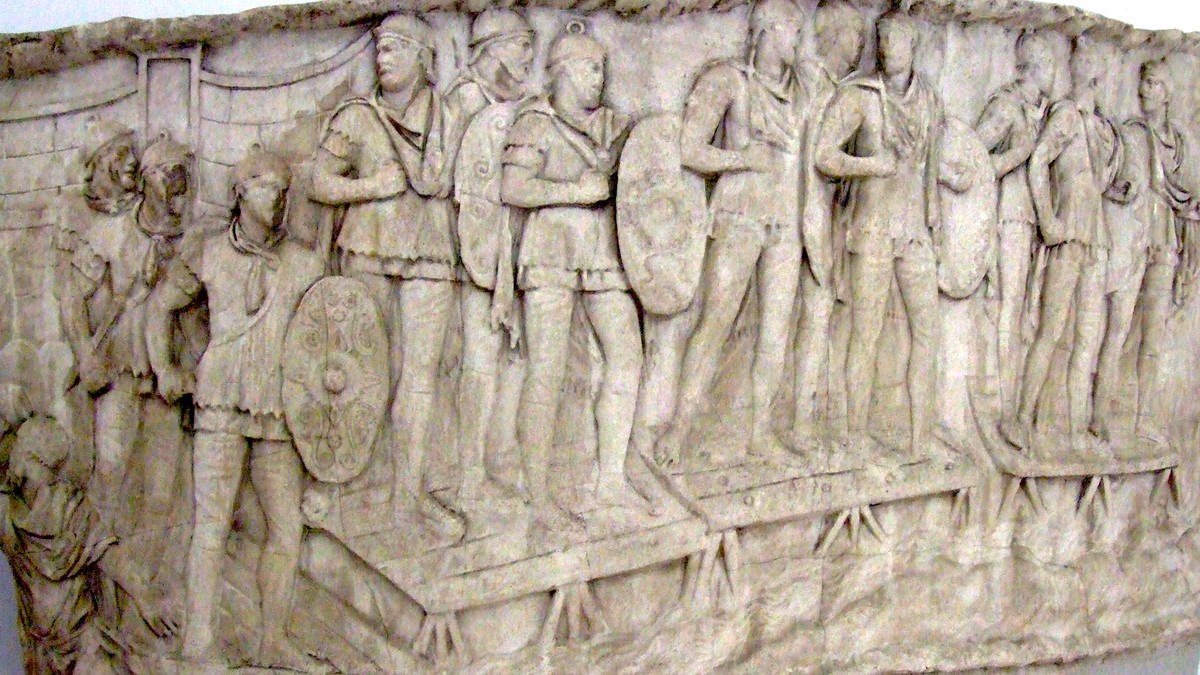
3. The Scutum (The Curved Rectangular Shield): An engineering marvel constructed from three cross-grain laminated plywood sheets glued with animal collagen, covered in canvas and calfskin, and reinforced with an iron or bronze boss (the umbo) and perimeter brass binding. Weighing over seven kilograms, the scutum’s cylindrical concave curvature wrapped around the legionary’s body, deflecting missiles and absorbing crushing axe blows. In offensive melee, the heavy iron umbo was slammed violently into an opponent’s face or chest to break his balance before the gladius struck.
4. Lorica Segmentata (Segmented Plate Armor): Introduced in the early first century CE. Comprising articulated horizontal iron bands connected by internal leather straps, brass hooks, and leather laces, the armor provided superior thoracic protection against downward chopping blows while granting the soldier full flexibility to maneuver and thrust.
🛡️ The Testudo: The Invincible Tortoise Formation
During sieges and under intense enemy missile fire, the legion executed the legendary Testudo (tortoise) formation. The front rank locked their large rectangular scuta edge-to-edge across their bodies; the flanking ranks turned outward, locking their shields along the flanks; while the interior ranks held their shields flat above their heads, overlapping like roofing tiles. Contemporary accounts record that the resulting shell was so dense and rigid that fully laden war chariots could be driven across the locked shields, completely rendering enemy arrows, javelins, and stones harmless.
4. Castramentation: The Mobile Fortress Architecture of the Marching Camp
Perhaps the most underappreciated, yet decisively decisive, component of Roman military superiority was the science of Castramentation—the standardized construction of fortified marching camps (the Castra). No Roman army, whether on peaceful maneuvers or deep in hostile territory in Germania, ever halted for the night without constructing an impregnable, full-scale fortified fortress.
Upon concluding the daily march in mid-afternoon, advanced surveyors (the mensores) planted colored signal flags on an elevated, well-watered site, marking out a standardized playing-card shaped rectangle. While half the legion stood guard in full battle armor, the remaining soldiers dropped their weapons and commenced construction using their entrenching tools. Within three to four hours, an army of ten thousand men excavated a continuous perimeter ditch (the fossa) three meters wide and two meters deep. The excavated earth was piled inward to form a raised earthen rampart (the agger), crowned with the interlocking wooden palisade stakes (valla) carried on their backs.
Internally, every Roman camp across the entire empire followed an identical, predictable orthogonal grid. The four fortified gates—the Porta Praetoria (front), Porta Decumana (rear), Porta Principalis Dextra (right), and Porta Principalis Sinistra (left)—were connected by wide thoroughfares. At the exact geometric center stood the Praetorium (the general’s headquarters), flanked by the Quaestorium (supply depot), the sacred legionary shrines housing the Eagles, and the military hospital (valetudinarium). Every century and cohort had an identical allocated tent footprint. If a sudden midnight ambush erupted, every Roman soldier knew his exact defensive station in total darkness without panic, neutralizing the terror of barbarian night assaults.
5. Siegecraft, Ballistics, and Polyiorcetics
When confronted by heavily fortified stone citadels, the Roman military transformed from an infantry strike force into a massive civil engineering apparatus. Utilizing the sophisticated Hellenistic science of siege warfare (polyiorcetics), Roman engineers deployed an array of torsion-powered mechanical artillery:
- The Ballista and Scorpio: High-velocity torsion crossbows powered by tightly twisted skeins of animal sinew and human hair. The compact Scorpio fired iron-tipped bolts up to four hundred meters with pinpoint accuracy, capable of skewering enemy defenders along defensive battlements.
- The Onager (‘The Wild Ass’): A massive single-armed torsion catapult that hurled stone boulders weighing up to thirty kilograms into stone curtain walls, battering ramparts into rubble through brute kinetic shock.
- Ramp Aggers and Circumvallation: At the Siege of Masada (73 CE) in the Judean desert, Roman engineers under Flavius Silva constructed a colossal stone and timber assault ramp soaring over seventy meters up a sheer cliff face to push a gigantic siege tower and battering ram against the fortress walls. Similarly, at the Siege of Alesia (52 BCE) in Gaul, Julius Caesar constructed a double wall of circumvallation (sixteen kilometers long) and contravallation (twenty-one kilometers long) fortified with booby-trapped pits (cippi and stimuli), simultaneously starving out eighty thousand Gauls inside while repelling a relieving army of a quarter-million warriors from the rear.
6. The Frontier Limes and the Transformation of Empire
During the Pax Romana of the first and second centuries CE, the nature of the legion transformed from mobile conquest to permanent static frontier defense along the imperial perimeter: the Limes. From the turf and stone barrier of Hadrian’s Wall spanning the width of northern Britain, to the fortified river watchtowers along the Rhine and Danube, Roman legions guarded the boundary separating classical civilization from the external barbarian world (Barbaricum).
These permanent frontier fortresses (castra stativa)—such as Vindolanda in Britain, Carnuntum on the Danube, and Mogontiacum on the Rhine—rapidly catalyzed urban civilization. Civilian settlements known as canabae formed outside the fortress walls, housing the wives, children, merchants, tavern owners, and blacksmiths who catered to the well-paid legionaries. Over decades, these military outposts evolved into monumental Roman cities with stone amphitheaters, public thermal baths, and paved fora—founding the modern metropolises of Vienna, York, Cologne, and Strasbourg. Through its blood, iron, and stone, the Roman legionary apparatus permanently forged the urban, linguistic, and infrastructural landscape of Europe.