🏛️ Civil Engineering Historiography Overview
An in-depth investigation into the revolutionary materials science, architectural mechanics, and hydraulic physics of ancient Roman monumental engineering. This monograph examines the chemical synthesis of pozzolanic concrete (opus caementicium), the structural load distribution of the true voussoir arch and dome, the hydraulic gradients of aqueduct bridges, and the trans-continental military road network (viae).
While the civilizations of classical Greece, ancient Egypt, and Mesopotamia produced sublime stone monuments through the post-and-lintel (trabeated) architectural system, the Roman Empire executed a radical materials-science and spatial revolution that fundamentally transformed the built environment of human civilization. The Greek structural paradigm was constrained by the tensile weakness of natural stone: because limestone and marble possess immense compressive strength but fracture easily under tensile stress, stone lintels could span only narrow horizontal distances, compelling Greek temples to be crowded with dense forests of interior columns.
The Roman engineering genius completely shattered this spatial limitation through two interconnected breakthroughs: the structural perfection of the True Arch (the compressive arcuated system) and the miraculous invention of Opus Caementicium—ancient Roman hydraulic concrete utilizing reactive volcanic ash. Armed with this liquid stone, Roman architects ceased viewing architecture merely as external mass and sculpture; instead, they conceptualized architecture as the creative shaping of vast, unbroken, luminous interior volume. Across three continents, Roman legions and civilian civil engineers constructed thousands of kilometers of paved military highways, towering multi-tiered hydraulic aqueduct bridges spanning rugged river valleys, massive vaulted thermal baths accommodating tens of thousands of citizens, and awe-inspiring hemispherical concrete domes that remain standing intact two millennia after the collapse of the empire.
1. The Materials Revolution: Pozzolana and Opus Caementicium
The foundational bedrock of Roman architectural supremacy was not stone, marble, or bronze, but a synthetic composite building material: Opus Caementicium (from which the modern word ‘cement’ derives). Unlike modern Portland concrete, which relies upon inert quartz sands and limestone clinker that progressively degrades when exposed to moisture and marine sulfates, Roman concrete was a chemically active, self-healing material of extraordinary longevity.
The secret of Roman concrete lay in its reactive volcanic aggregate: Pulvis Puteolanus (modern Pozzolana), a reactive volcanic ash harvested from extensive volcanic deposits around the Gulf of Naples (near Puteoli) and the Alban Hills near Rome. To manufacture this miraculous material, Roman builders burned pure limestone in high-temperature kilns to produce quicklime (calcium oxide, CaO), which was slaked with water to create slaked lime putty (calcium hydroxide, Ca(OH)2). This slaked lime was blended with pozzolanic volcanic ash and mixed with aggregate rubble (caementa) consisting of fist-sized chunks of tuff, travertine, broken terracotta tiles, and basalt.
Recent micro-diffraction X-ray spectroscopy conducted by materials scientists at MIT and the Lawrence Berkeley National Laboratory has unlocked the atomic chemistry that granted Roman concrete its indestructible properties. When slaked lime reacted with the reactive aluminosilicates of volcanic pozzolana, it formed a robust matrix of calcium-silicate-hydrate (C-S-H). Crucially, the hot-mixing process left behind microscopic ‘lime clasts’—undissolved calcium-rich mineral inclusions throughout the concrete mass. When microscopic fractures and fissures developed over centuries due to seismic stress or environmental weathering, water entering the cracks dissolved these lime clasts, precipitating pure calcium carbonate that recrystallized within the fissures, effectively self-healing the cracks automatically before structural failure could occur.
Furthermore, in maritime environments (such as harbor moles, breakwaters, and lighthouses at Caesarea Maritima and Ostia), seawater reacting with pozzolana and aluminum-rich phillipsite catalyzed the growth of interlocking crystal structures of Al-tobermorite—an exceptionally rare, robust layered silicate mineral that actually strengthened the concrete over centuries as seawater washed through its crystalline pore network.
| Roman Engineering Structure | Key Architectural Mechanism | Materials Science Composition | Functional Societal Objective |
|---|---|---|---|
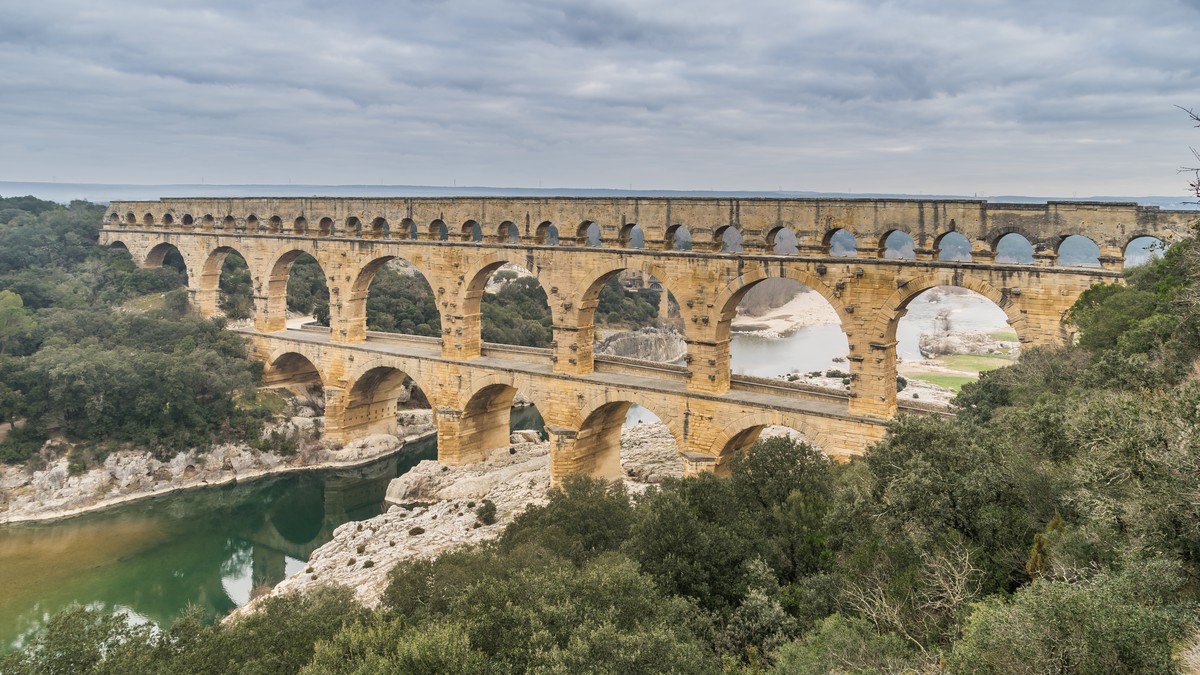
| Pont du Gard (Nîmes, Gaul) | 3-tiered gravity arch bridge; 1:3000 hydraulic gradient | Shelly limestone ashlars assembled without mortar; iron cramp anchors | Transporting 40,000 m³ of freshwater daily across Gardon river valley |
| The Pantheon (Rome) | Unreinforced hemispherical coffered dome (43.3m diameter) | Graded density concrete (dense basalt at base, porous pumice at oculus) | Cosmological temple dedicated to all planetary gods; monumental unbroken interior |
| Baths of Caracalla (Rome) | Colossal cross-groin vaults (groin vaults) | Brick-faced concrete (opus testaceum); hypocaust subterranean heating | Imperial public leisure facility housing 1,600 bathers; socio-political patronage |
| Via Appia (Rome to Brundisium) | Multi-layered layered roadbed (Statumen, Rudus, Nucleus, Summum Dorsum) | Polygonal basalt paving blocks (silices) crowned for drainage | Rapid strategic troop deployment; commercial trans-Mediterranean logistics |
| Cloaca Maxima (Rome) | Semi-circular barrel-vaulted masonry sewage conduits | Dense volcanic peperino and travertine arch blocks | Draining Forum marshes into the Tiber; municipal sanitation and flood defense |
2. Structural Physics: The True Arch, The Vault, and The Dome
While the Etruscans and ancient Near Eastern cultures had experimented with primitive arches, the Romans were the first to fully understand the structural physics of the compressive True Arch and transform it into the universal building block of empire. The core genius of the voussoir arch is that it eliminates tensile stress by converting the downward vertical gravitational pull of massive overhead masonry into lateral, diagonal compressive thrust forces.
The construction of a true arch proceeded through precise mechanical steps:
- Centering (Centrum): Carpenters erected a temporary wooden timber framework shaped to the exact curvature of the intended arch.
- Voussoirs: Wedge-shaped stone blocks (voussoirs) were laid across the wooden centering, ascending from the springers on both sides toward the center.
- The Keystone (Clavis): At the central apex, the wedge-shaped keystone was hammered into position. Once the keystone was locked, the gravitational load pressed the voussoirs tightly against one another, transferring compressive loads downward into the massive vertical piers or abutments. The wooden centering was then dismantled; the arch stood entirely through the physics of its own compressed mass.
By extending the two-dimensional arch along a longitudinal axis, Roman engineers created the Barrel Vault (or tunnel vault), capable of roofing continuous, heavy subterranean corridors. By intersecting two barrel vaults at right angles, they invented the Groin Vault (or cross-vault). This was a monumental structural breakthrough: instead of requiring continuous solid stone load-bearing walls along the entire length of a building, the groin vault concentrated all roof weight onto four discrete corner piers. This allowed Roman architects to knock out the intervening walls and replace them with soaring clerestory windows, flooding the interior spaces of imperial basilicas and thermal bath complexes with natural sunlight.
Finally, by rotating an arch 360 degrees around a central vertical axis, Roman engineers produced the Dome (Rotunda)—the supreme structural triumph realized in the Pantheon of Rome, commissioned by Emperor Hadrian (c. 125 CE). Rising to an interior height of 43.3 meters (which exactly equals its interior diameter, forming a perfect mathematical sphere enclosed within a cylinder), the Pantheon’s dome remains to this day the largest unreinforced concrete dome in human history. To achieve this architectural impossibility without modern steel rebar reinforcement, Roman engineers utilized a brilliant strategy of graded material density: the lowest foundation wall (six meters thick) was cast using heavy basalt aggregate; as the dome ascended, builders progressively substituted lighter aggregates—tuff, broken terracotta urns, and finally, around the open nine-meter central eye (the Oculus), ultra-light porous volcanic pumice, while cutting five concentric rings of receding coffers into the interior ceiling to shave hundreds of tons of deadweight from the apex.
3. Hydraulic Engineering: Aqueducts, Inverted Siphons, and The Gradient Science
The sheer scale of Roman urbanism—with the city of Rome supporting a population exceeding one million inhabitants during the second century CE—depended upon a constant, clean, high-volume water supply. While other ancient metropolises relied upon contaminated local wells and polluted rivers, Rome constructed eleven colossal Aqueducts spanning an aggregate length of over 500 kilometers, delivering over 1.2 billion liters of pristine mountain spring water into the city every single day.
Popular imagination envisions aqueducts as continuous soaring stone bridges crossing the landscape. In reality, over eighty percent of the aqueduct network was constructed completely underground. Subterranean masonry conduits, lined with water-resistant hydraulic cement (opus signinum, prepared from crushed pottery mixed with lime), wound through mountain tunnels and along natural contours. This underground routing served two critical purposes: it protected the water supply from surface evaporation, algae growth, and summer heat, while safeguarding the empire’s vital infrastructure from sabotage by foreign invaders during military sieges.
The technical mastery of Roman hydraulic engineers (the aquilegi) lay in their ability to maintain an excruciatingly precise, continuous downward gravitational gradient over distances exceeding eighty kilometers. If the gradient was too steep, the rushing torrent would scour and destroy the hydraulic mortar lining; if the gradient was too gentle, the water would stagnate and deposit thick calcium carbonate sinter. Utilizing the Chorobates—a six-meter-long wooden leveling instrument featuring plumb lines and a water groove—Roman engineers maintained gradients as delicate as 1:3,000 (a vertical drop of merely thirty-four centimeters per kilometer).
💧 Inverted Siphons: Conquering Deep Valleys with Hydraulic Pressure
When an aqueduct encountered a canyon too wide and deep to span with stone bridges, engineers deployed the Inverted Siphon. Water flowed into a high elevation header tank, descended through sealed lead or terracotta pipelines down the steep slope, crossed the valley floor over a low bridge, and climbed up the opposing hill into a receiving tank via hydrostatic pressure (communicating vessels). Because lead pipes were subjected to immense hydraulic pressure at the valley floor (exceeding twenty atmospheres), Roman engineers divided the flow across up to nine parallel lead pipes to distribute burst stress safely.
4. The Arteries of Empire: The Engineering of the Viae
The famous aphorism ‘All roads lead to Rome’ reflects a concrete physical reality: by the height of the Antonine era, the Roman state had paved over 85,000 kilometers of first-class military highways (the Viae Publicae), supplemented by over 300,000 kilometers of secondary paved roads linking Scotland to the Persian Gulf. Engineered primarily by Roman legionaries during peacetime, these highways served as the vital nervous system of empire, enabling rapid troop redeployment, administrative governance by the imperial courier service (the Cursus Publicus), and continental-scale commercial trade.
A primary Roman highway—such as the Via Appia (‘The Queen of Long Roads’) connecting Rome to the Adriatic port of Brundisium—was not a simple gravel trail, but a multi-layered civil engineering hyper-structure excavated over a meter into the subsoil:
- The Fossa: Legionaries excavated a deep trench down to solid geological bedrock (the gremium).
- The Statumen: A foundational bed of large, fist-to-head-sized stones and lime mortar, twenty to thirty centimeters thick, providing a non-shifting foundation.
- The Rudus: A dense layer of crushed gravel, broken pottery, and lime concrete, thoroughly compacted with heavy wooden rammers.
- The Nucleus: A fine layer of cement mixed with gravel and crushed brick, smoothed and leveled to support the paving stones.
- The Summum Dorsum (Pavimentum): The surface pavement, constructed from polygonal slabs of indurated volcanic basalt (silices) or granite, fitted together with such microscopic precision that a knife blade could not be inserted between the joints. The surface was deliberately crowned with a convex camber, shedding rainwater into stone gutters flanked by raised pedestrian curbstones.
5. Municipal Sanitation: The Cloaca Maxima and Public Hygeia
Roman civilization was defined by its acute municipal sanitation infrastructure. At the center of Rome, the Cloaca Maxima (‘The Greatest Sewer’) originated in the sixth century BCE as an open drainage canal engineered by Etruscan builders to drain the swampy valley between the Palatine and Capitoline Hills, allowing the creation of the Roman Forum.
During the late Republic and early Empire, Agrippa enclosed the canal within a monumental barrel-vaulted stone tunnel over four meters wide and four meters high—spacious enough that Agrippa famously navigated the sewer in a boat during an official inspection tour. The sewer drained wastewater, storm runoff, and sewage from the city’s private residences, imperial thermal baths, and communal multi-seat public latrines (foricae) directly into the Tiber River. While modern epidemiology recognizes the biological hazards of discharging sewage into a river used downstream, the continuous flushing of millions of liters of overflow water from the aqueducts through the subterranean sewers kept Rome remarkably free from the devastating stagnant waterborne plagues that perpetually ravaged other ancient urban populations.
6. The Architectural Legacy: From Rome to Modern Civic Spaces
The monumental engineering legacy of Rome permanently redefined human civilization. The architectural vocabulary developed by Roman engineers—the triumphant arch, the vaulted basilica, the colossal sports amphitheater (the Colosseum), and the monumental domed civic hall—survived the collapse of the Western Empire to become the universal architectural language of Western power.
When Renaissance masters such as Brunelleschi designed the dome of Santa Maria del Fiore in Florence, and Michelangelo conceived the soaring dome of St. Peter’s Basilica in the Vatican, they spent months in Rome excavating, measuring, and analyzing the pozzolanic concrete and brick arches of the Pantheon and the Baths of Caracalla. Across the Atlantic, the founders of the American Republic explicitly adopted Roman monumental architecture—designing the United States Capitol, the Supreme Court, and the Thomas Jefferson rotunda at the University of Virginia with Roman porticos, arches, and domes—to physically encode Roman republican ideals into the stones of their new nation. Two thousand years after the last legionary laid down his pickaxe, the concrete and stone monuments of Rome remain silent, unyielding sentinels to human technical mastery.