⚔️ Classical Martial Historiography Overview
A rigorous scholarly deconstruction of the Spartan social order, the Great Rhetra of Lycurgus, the brutal educational-military indoctrination of the Agoge, the economic exploitation of the subjugated Helot population, and the tactical mechanics of the Spartan hoplite phalanx that established hegemony across Archaic and Classical Hellas.
In the collective historical consciousness of the Western tradition, classical Sparta (ancient Greek: Lacedaemon) occupies a position of extraordinary, almost mythical fascination. Celebrated for unyielding martial discipline, laconic speech, contempt for material luxury, and legendary defiance at the Hot Gates of Thermopylae, the Spartan state has frequently been romanticized as an egalitarian utopia of iron-willed warrior-citizens. Modern classical scholarship, however—pioneered by historians such as François Ollier, Paul Cartledge, and Anton Powell—has demonstrated that much of this idealized imagery represents the ‘Spartan Mirage’ (le mirage spartiate): a carefully crafted ideological façade perpetuated by contemporary Athenian oligarchic sympathizers (including Xenophon and Plato) and cultivated deliberately by the Spartans themselves to project an aura of invulnerability.
Behind the glittering martial mirage lay an exceptionally rigid, militarized totalitarian oligarchy whose supreme military specialization was born not from imperial ambition, but from profound, structural paranoia. The entirety of Spartan society was engineered to solve a singular, existential domestic dilemma: how a tiny ruling minority of full citizens—the Spartiates (or Homoioi, ‘the Equals’)—numbering never more than nine thousand men, could maintain absolute dominion over a permanently hostile, disenfranchised population of hundreds of thousands of agricultural serfs: the Helots. To prevent catastrophic domestic rebellion, the legendary lawgiver Lycurgus instituted a social, political, and educational matrix that transformed every Spartan male from birth into an interchangeable, state-owned cog within the most fearsome shock infantry phalanx in the ancient Mediterranean basin.
1. The Lycurgan Constitution and the Great Rhetra
The foundational charter of the Spartan state was the Great Rhetra, an archaic constitutional decree ostensibly delivered to the legendary lawgiver Lycurgus by the Delphic Oracle of Apollo. The Lycurgan constitution created a unique, highly stable ‘mixed constitution’ praised by Aristotle and Polybius, combining elements of monarchy, oligarchy, and democracy in delicate structural tension:
- Dual Kingship (Diarchy): Two hereditary kings reigning simultaneously from two separate royal houses: the Agiads and the Eurypontids, both claiming direct patrilineal descent from the mythical hero Heracles. One king led military campaigns abroad as commander-in-chief, while the other remained in Laconia to maintain domestic stability and perform sacred religious sacrifices.
- The Ephors (Five Overseers): The supreme executive magistrates, elected annually from among all citizens. The Ephors wielded extraordinary supervisory authority: they could fine, arrest, and indict magistrates; declare annual ritual war upon the Helots; accompany the king on campaign to scrutinize his conduct; and even impeach or imprison the kings for constitutional transgressions.
- The Gerousia (Council of Elders): An oligarchic senate consisting of twenty-eight elders aged sixty or older, elected for life by public acclaim, alongside the two kings. The Gerousia possessed supreme criminal judicial authority (including capital jurisdiction over kings) and exercised legislative veto power (probouleuma) over all motions presented to the citizen assembly.
- The Apella (Citizen Assembly): Comprising all full Spartiate citizens aged thirty and above. The assembly voted on wars, alliances, treaties, and disputed royal successions, but lacked the right of open debate; citizens voted merely by acclamation (shouting), with presiding magistrates gauging the loudest volume.
| Spartan Social Stratum | Legal Standing & Civil Rights | Economic Function & Labor | Demographic Ratio to Spartiates |
|---|---|---|---|
| Homoioi (Spartiates) | Full civil, political, and voting rights; strictly prohibited from manual labor or trade | Professional full-time hoplite soldiers; supported by inalienable state land allotments (kleroi) | Ruling minority: 8,000–9,000 (c. 480 BCE) declining to under 1,000 by 371 BCE |
| Perioikoi (‘Dwellers-Around’) | Free autonomous citizens of Laconian/Messenian towns; no Spartan voting rights | Merchants, craftsmen, bronzesmiths, armorers, and auxiliary military hoplites | Estimated 3:1 to 4:1 ratio; economic backbone of Spartan metalworking and trade |
| Helots (Messenians & Laconians) | State-owned chattel serfs tied permanently to agrarian soil; legally hunted and executed | Agricultural production; bound to surrender half of all harvest yields to Spartiate masters | Massive majority: estimated 7:1 to 10:1 ratio; constant threat of violent rebellion |
| Hypomeiones (‘Inferiors’) | Disenfranchised former Spartiates who lost civil rights due to economic bankruptcy or cowardice | Excluded from mess halls and voting; performed secondary administrative and military duties | Growing disenfranchised class; primary instigators of domestic conspiracies (e.g., Cinadon) |
2. The Helot Subjugation and The Cryptic Terror of the Krypteia
The economic prerequisite for the Spartan warrior lifestyle was the total subjugation of the fertile territory of Messenia, conquered by Sparta during the bloody First and Second Messenian Wars of the eighth and seventh centuries BCE. The conquered Messenian Greeks were reduced to the status of Helots—state-owned serfs bound perpetually to the land. Unlike chattel slaves in Athens, who were bought and sold as individual private property, Helots belonged to the collective Spartan state and could not be freed or sold by individual masters.
Each Spartiate warrior was allocated an inalienable state agricultural estate (the kleros), worked by several Helot families who were compelled under penalty of death to cultivate the soil and surrender a fixed annual quota (the apophora) of barley, wine, figs, and cheese to their Spartiate master. This institutionalized serfdom liberated the Spartan warrior from all manual labor, trade, and economic enterprise, allowing him to devote his entire life to physical conditioning and military tactics.
However, the staggering demographic imbalance—with Helots outnumbering their Spartiate masters by as much as seven or ten to one—created permanent societal terror in Laconia. Thucydides bluntly observed: ‘Spartan policy is always mainly governed by the necessity of taking precautions against the Helots.’ To institutionalize state terror, the newly elected Ephors performed an annual ritual declaration of war upon the Helots each autumn, legally allowing Spartiate citizens to assassinate any Helot without incurring religious blood-guilt or pollution (miasma).
The enforcement arm of this domestic terror was the Krypteia (‘the Secret Police’). Comprising the most ruthless, intelligent young Spartiate graduates of the Agoge, these young operatives were dispatched into the Laconian and Messenian countryside armed only with concealed daggers and minimal food rations. Concealing themselves in ravines and forests by day, they hunted by night, assassinating any Helot caught traveling after dusk and systematically murdering prominent, charismatic, or physically strong Helots who exhibited potential leadership traits, pre-emptively decapitating any revolutionary momentum.
3. The Agoge: State Indoctrination from Cradle to Battlefield
In classical Sparta, the individual did not belong to parents or family, but to the commonwealth. The institutional indoctrination of the Spartan male commenced at the moment of birth. Newborn infants were examined by a state council of elders at the Lesche. If the child appeared frail, malformed, or sickly, it was abandoned to perish in the chasm of Mount Taygetus known as the Apothetae (‘the place of rejection’), ensuring that state resources were expended only upon infants capable of developing into robust hoplite warriors or fertile mothers.
At age seven, the male child was permanently removed from his maternal household and enrolled into the state educational and military system: the Agoge (‘the Rearing’). Organized into packs (agelai) commanded by senior youths, boys were subjected to a brutal thirteen-year curriculum designed to eradicate individuality, cultivate unthinking obedience, and build extraordinary pain tolerance:
- Physical Hardening: Boys were forced to go barefoot across rocky terrain year-round, wore only a single rough wool mantle (chiton) even in winter snows, slept on reed mats harvested by hand from the Eurotas River without knives, and bathed rarely in cold mountain streams.
- Institutional Starvation and Theft: Rations were deliberately kept meager to maintain lean, agile bodies and simulate campaign starvation. Boys were actively encouraged to steal food from communal storehouses and kitchens; however, if captured, they were brutally whipped not for the moral crime of theft, but for the military incompetence of being caught.
- The Ritual Scourging (Diamastigosis): At the sanctuary of Artemis Orthia, adolescent youths were subjected to competitive public floggings with leather scourges until their blood covered the altar, competing to see who could endure the maximum trauma without crying out, with parents cheering from the sidelines.
- Laconic Speech and Intellectual Conditioning: Literary education was limited to basic literacy, the recitation of Homeric epic poetry, and the martial elegies of Tyrtaeus. Boys were trained to speak with extreme brevity, cutting directly to the practical core of an argument with razor-sharp wit—the origin of the modern word ‘laconic’.
4. The Syssitia: Commensality, Equality, and Social Cohesion
Upon surviving the Agoge at age twenty, the young warrior faced his supreme civic hurdle: election to a common dining mess, the Syssition (or Pheidition). Comprising approximately fifteen warriors of varying ages, the Syssition was the foundational social, emotional, and tactical unit of the Spartan state. Admission required the unanimous approval of existing members, who voted by dropping bread pellets into a vessel (a squashed pellet indicating rejection). A single negative vote resulted in permanent exclusion, consigning the failed applicant to the disenfranchised class of the Hypomeiones (‘Inferiors’).
Within the Syssition, warriors consumed identical, unadorned meals—most famously the Spartan ‘black broth’ (melas zomos), prepared from boiled pork, vinegar, and pig’s blood—and engaged in military planning, camaraderie, and patriotic singing. Crucially, every member was required to contribute a monthly quota of agricultural produce derived from his kleros. If a citizen’s estate failed to produce the mandatory quota due to economic mismanagement or land fragmentation, he was automatically stripped of his Spartiate status and demoted from full citizenship, a fatal structural flaw that ultimately doomed the Spartan military machine.
🏛️ Spartan Women: Physical Freedom and Economic Power
Unlike Athenian women, who were sequestered inside the home and possessed no economic independence, Spartan women enjoyed unprecedented autonomy. Unmarried girls engaged in rigorous outdoor athletics—running, wrestling, and javelin throwing—to cultivate healthy bodies capable of bearing robust warrior sons. Because Spartiate men spent their entire lives in barracks and on campaign, women managed the great agricultural estates. By the fourth century BCE, through inheritance and dowries, Spartan women owned over two-fifths of all private land in Laconia, wielding immense economic and political influence.
5. The Mechanics of the Hoplite Phalanx and Hegemonic Warfare
The operational culmination of the Spartan educational and social apparatus was the devastating effectiveness of its shock heavy infantry formation: the Hoplite Phalanx. While other Greek poleis assembled amateur citizen militias who broke into disorganized running charges, the Spartan army operated as a professional, highly disciplined military machine divided into hierarchical subdivisions: the mora (regiment), the lochos (battalion), the pentekostys (company), and the enomotia (platoon).
Every Spartan warrior was equipped with the standardized hoplite panoply:
- The Aspis (Hoplon): A heavy, circular concave wooden shield measuring roughly one meter in diameter, constructed from laminated oak, faced with bronze, and emblazoned with the crimson Greek letter Lambda (Λ) for Lacedaemon. The shield was held across the left forearm using the revolutionary double-grip system (the central bronze porpax armband and the perimeter leather antilabe cord), protecting both the bearer’s left flank and the exposed right flank of the comrade standing immediately to his left.
- The Dory: A primary thrusting spear measuring 2.5 to 3 meters in length, fashioned from straight-grained ash wood and tipped with a leaf-shaped iron head and a bronze butt-spike (the sauroter, or ‘lizard-killer’), which provided counterweight balance and allowed the warrior to strike fallen enemies while the spear was raised.
- The Xiphos: A short bronze or iron leaf-bladed slashing sword, or the curved kopis, designed for brutal close-quarters hacking once spear formations fractured in the press of bodies (othismos).
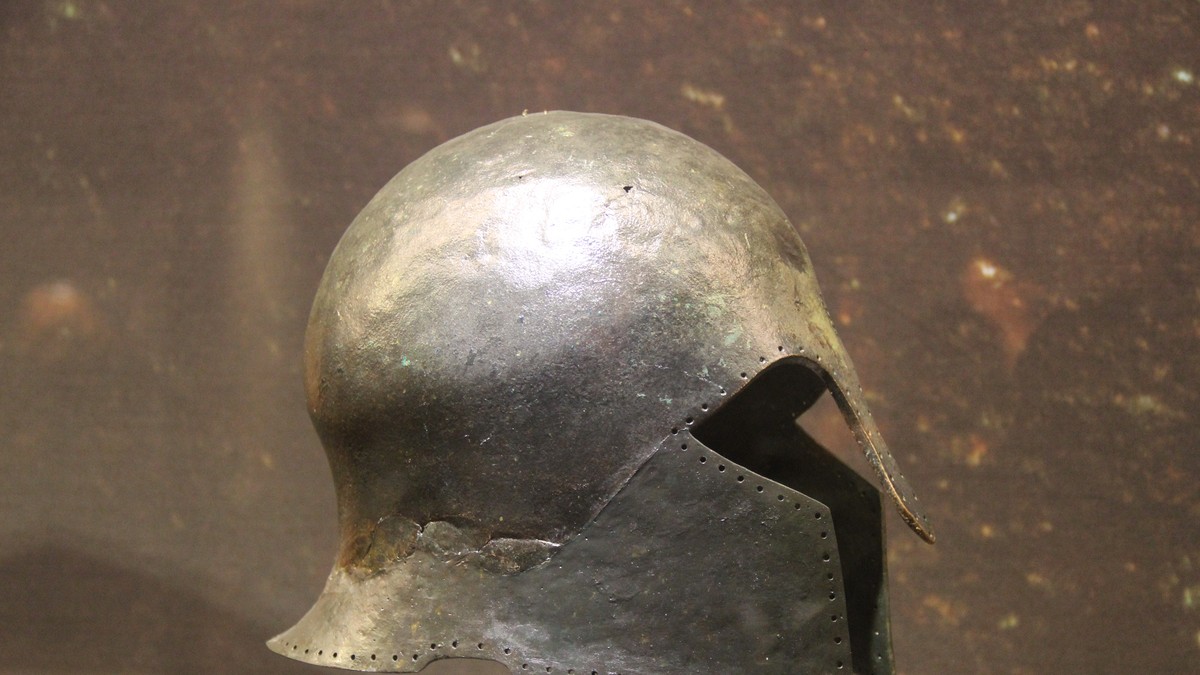
On the battlefield, Spartan hoplites marched into combat in absolute lockstep, advancing silently to the rhythmic melodies of double-piped reed flutes (the aulos), their crimson cloaks billowing and their long oiled hair flowing from beneath polished Corinthian bronze helmets. This chilling psychological calm contrasted violently with the frantic war cries of opposing armies. In battle, Spartan tactical drills allowed them to execute complex wheeling maneuvers, feigned retreats, and echelon formations that routinely shattered the flanks of opposing Greek forces, securing Spartan military supremacy at Plataea, Mantinea, and the Nemea River.
6. Oliganthropia and The Collapse at Leuctra
The ultimate tragedy of the Spartan state was that its rigid, unyielding domestic structure contained the seeds of its own destruction. The defining crisis of late classical Sparta was oliganthropia (‘shortage of men’). Through relentless warfare (most notably the Peloponnesian War and Corinthian War), strict citizen criteria, earthquake casualties, and the progressive concentration of kleroi estates into the hands of a few wealthy heiresses, the number of full Spartiate citizens plummeted from over 8,000 at the Battle of Plataea (479 BCE) to fewer than 1,000 by 371 BCE.
The catastrophic reckoning arrived on the plain of Leuctra (371 BCE) in Boeotia. Confronted by the innovative Theban general Epaminondas, the legendary Spartan phalanx was shattered. Epaminondas deployed his elite Theban Sacred Band and heavy strike column fifty ranks deep on his left wing—directly opposite the Spartan King Cleombrotus and his royal bodyguard—while holding back his weaker right wing in an echelon formation. The crushing mass of the fifty-deep Theban phalanx smashed through the eight-deep Spartan royal wing, killing King Cleombrotus and four hundred of the seven hundred Spartiates present.
Following Leuctra, Epaminondas invaded Laconia, liberated the Messenian Helots after three centuries of enslavement, and founded the fortified citadel of Messene. Stripped of their agricultural serfs and economic foundation, the Spartans were reduced to a second-rate regional power, unable to recover their ancient hegemony. The Spartan mirage finally evaporated, leaving behind a stark historical lesson on the limits of an exclusively martial society built upon human exploitation and unyielding ideological conservatism.